Announcements

Current Issue

Vol. 6 No. 2 (2025)

This issue reaffirms Jurnal Penelitian Ilmu-Ilmu Sosial (JPIIS) as an interdisciplinary scholarly forum that brings together critical inquiries into education, psychology, religion, technology, and social movements within both Indonesian and global contexts. The eight articles featured in this volume collectively address pressing contemporary social issues through empirical investigation, theoretical reflection, and methodological diversity.

Several contributions foreground educational and developmental concerns, particularly among adolescents. The study examining the role of religiosity in enhancing academic persistence among adolescents living in orphanagesdemonstrates that religiosity functions as a significant psychosocial resource that supports resilience, motivation, and future-oriented goal setting. By situating religiosity beyond a purely normative framework, this article contributes to broader discussions on educational persistence among marginalized youth populations.

Issues of intergroup relations and social psychology are critically explored in the article on collective narcissism, symbolic threat, and antisemitic conspiracy beliefs. Despite the minimal presence of Jewish communities in Indonesia, the study provides compelling empirical evidence showing how symbolic threat mediates the relationship between collective narcissism and conspiratorial thinking. This work extends intergroup relations literature by highlighting the sociopsychological mechanisms underlying prejudice formation in contexts characterized by symbolic rather than direct intergroup contact.

The intersection of educational philosophy and digital transformation is addressed through a systematic literature review of progressive pedagogies and digital integration. This article identifies both the potential of digital technologies to enhance learner agency, critical thinking, and inclusivity, as well as the structural and epistemological barriers that hinder their effective implementation. The review underscores an ongoing epistemological shift toward viewing knowledge as dynamic, co-constructed, and mediated through digital interaction.

Adolescent interpersonal development is further examined in a quantitative study on self-concept and friendship quality among female students in all-girls full-day schools. The findings highlight the central role of self-concept in shaping the quality of peer relationships, offering practical implications for educational environments that aim to support social and emotional development among adolescent girls.

Higher education quality assurance is addressed through a mixed-methods analysis of lecturers’ competencies based on students’ perceptions. The study integrates quantitative assessments with qualitative insights to provide a comprehensive picture of pedagogical, professional, social, and personal competencies. While overall competency levels are rated highly, the findings point to the need for pedagogical innovation, greater digital engagement, and alignment with Outcome-Based Education (OBE) principles.

Mental health and community-based advocacy emerge as a key theme in the qualitative case study of Griya Schizofren in Surakarta. Conceptualized as a New Social Movement, the initiative demonstrates how psychosocial support, creative economic activities, and cross-sector collaboration can humanize individuals with mental health problems while simultaneously challenging stigma and social exclusion. This contribution enriches sociological discussions on social movements and mental health advocacy in Indonesia.

The growing influence of artificial intelligence in education is critically examined in a study on EFL students’ perceptions of the use and abuse of AI-based tools. The findings reveal a nuanced awareness among students regarding the benefits of AI for learning efficiency and the risks associated with overreliance, particularly concerning academic integrity, creativity, and critical thinking. The study highlights the urgency of integrating ethical and digital literacy frameworks within higher education curricula.

Finally, a socio-legal analysis grounded in maqāṣid al-sharīʿah addresses the issue of personal data protection in the age of artificial intelligence. By emphasizing justice, public benefit, and the protection of human dignity, the article offers a normative and ethical framework for regulating AI-driven technologies. It contributes an Islamic legal perspective to global debates on data ethics and technological governance.

Taken together, Volume 6, Number 2 (2025) reflects JPIIS’s commitment to publishing scholarship that is empirically grounded, theoretically informed, and socially relevant. The diversity of perspectives and methodologies presented in this issue underscores the journal’s openness to interdisciplinary dialogue and its ongoing invitation to researchers, academics, and practitioners to contribute rigorous and impactful work to future issues.

Published: 2025-11-06

Articles

View All Issues
About Journal
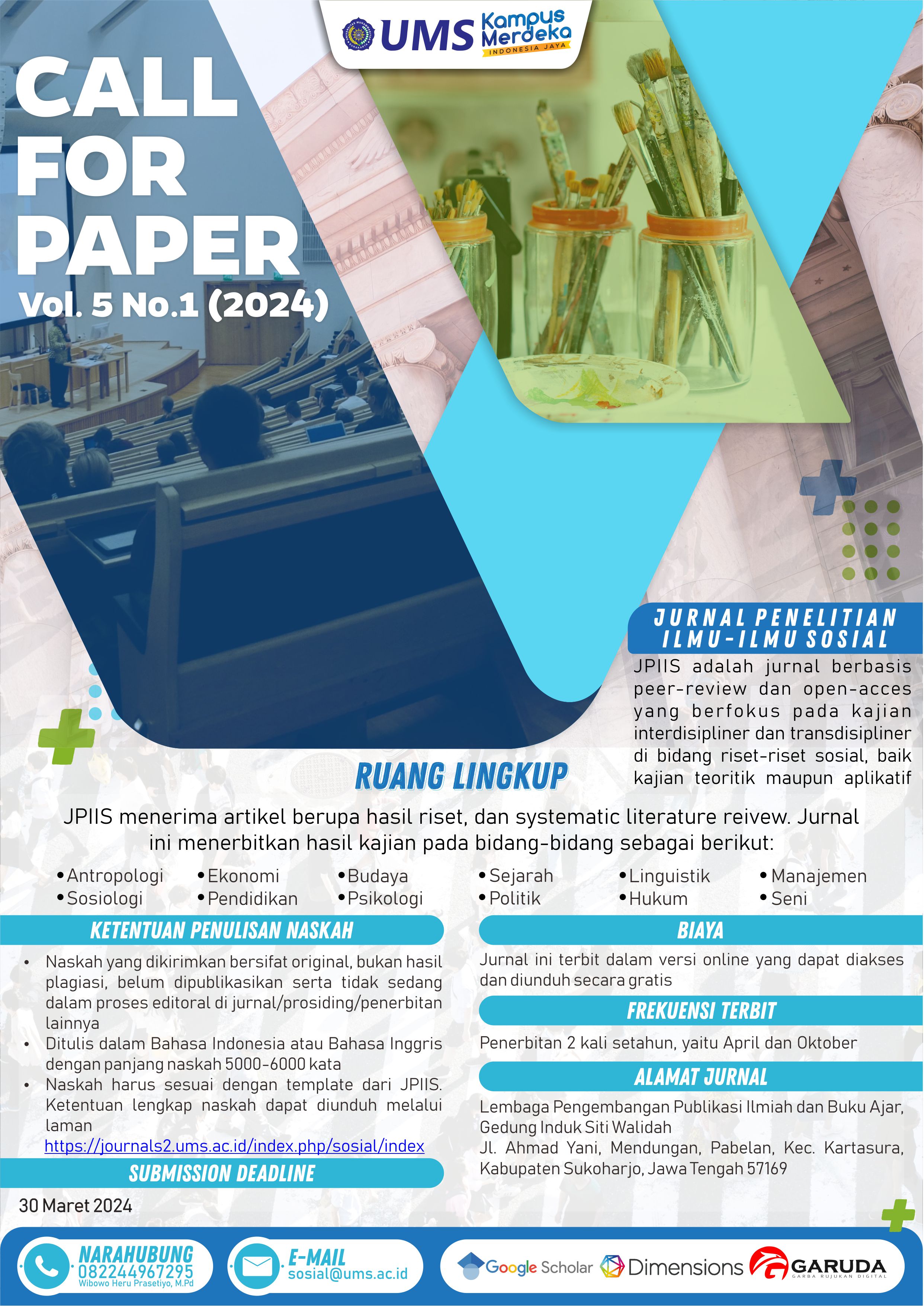
Jurnal Penelitian Ilmu-Ilmu Sosial is a multi and interdisciplinary peer-reviewed academic research journal serving the broad social sciences community. The journal welcomes excellent contributions that advance our understanding on a broad range of topics including anthropology, education, psychology, law and sociology.

This journal is an open access journal that publishes twice a year (April and October). Submissions are evaluated on their academic rigor and methodological soundness. All submitted manuscripts will be initially reviewed by editors and are then evaluated by two reviewers through the double-blind review process. We strive to provide our authors and readers with a responsive and efficient service and offer them a highly respected home for their research. Before submission, the author(s) must adhere to the author guidelines.
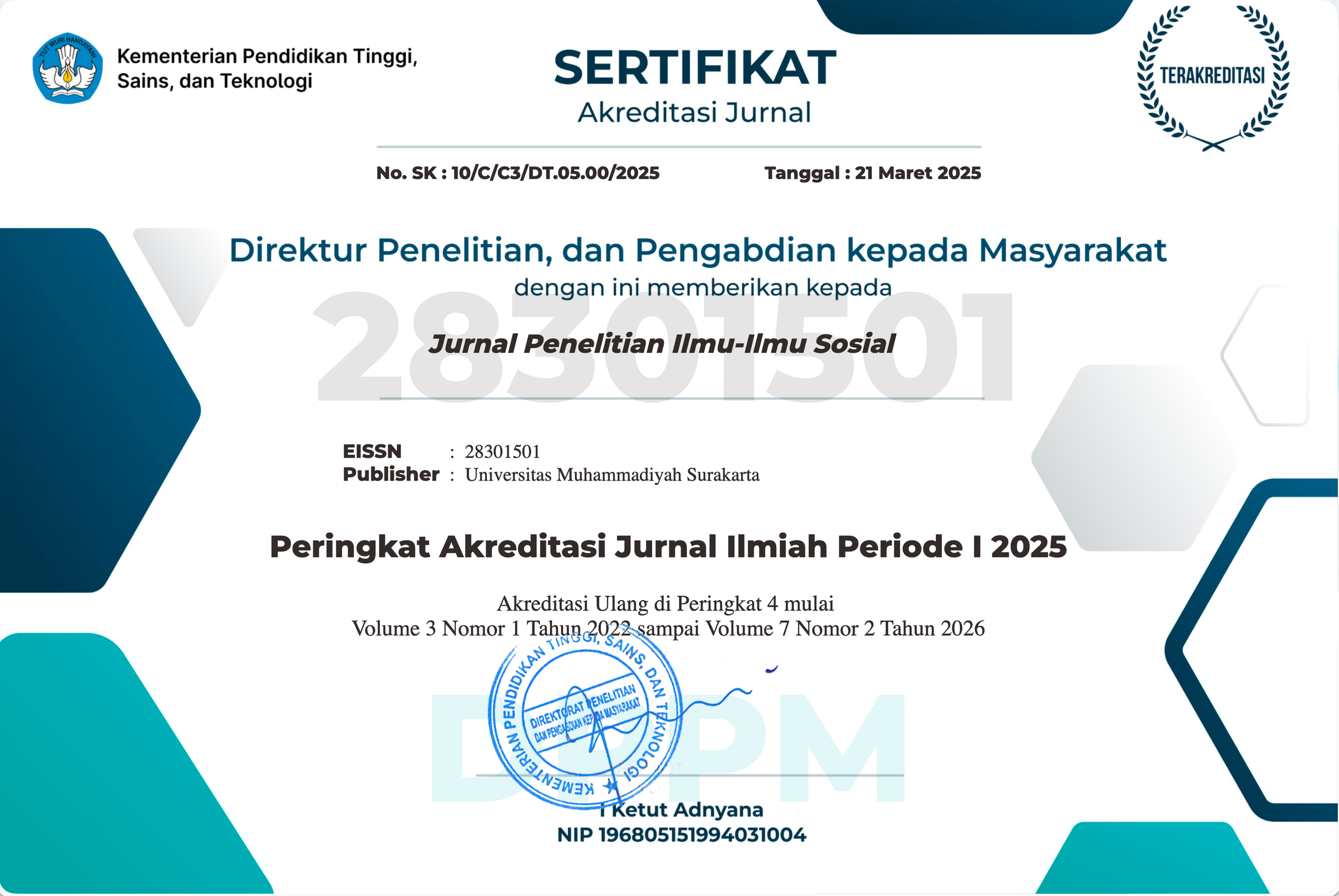
Jurnal Penelitian Ilmu-Ilmu Sosial has been accredited with SINTA 4 in accordance with the SK Dirjen Riset dan Pengembangan Kemendikti Saintek No 10/c/c3/dt.05.00/2025.
Title: Jurnal Penelitian Ilmu-Ilmu Sosial
Initials: sosial
Abbreviation: sosial
Publications: Semi Annually
ISSN: 1411-5182 (Print)
ISSN: 2830-1501 (Online)
National Accredited: SINTA 4 (Vol 3, No 1, 2022 - Vol 7, No 2, 2026) (SK. No. 0173/C3/DT.05.00/2025)
Publisher: Universitas Muhammadiyah Surakarta, Indonesia